
Address
Milli Eğitim Bakanlığı, Strateji Geliştirme Başkanlığı
Türkiye Eurydice Ulusal Birimi , Merkez Bina 4.Kat
B-Blok Bakanlıklar
TR-06648, Ankara /TÜRKİYE
Tel:+90 312 413 1484
E-Mail:
Website:
2025
E-book on “The Past, Present, and Future of Lifelong Learning"
The e-book “The Past, Present, and Future of Lifelong Learning” was published by the Directorate General for Lifelong Learning on the Directorate’s website on 17 January 2025. The book examines the historical development of the concept of lifelong learning up to the present day, also elaborating on the philosophy of lifelong learning. It provides detailed information on the importance of lifelong learning in individuals’ lives and on the work carried out by our Directorate in this area.
Family Training Books on Special Education
With preparatory work completed in 2024, Family Training Books on Special Education in Hearing Impairment and Visual Impairment were improved in terms of content and accessibility in 2025, and were made available for relevant stakeholders.
Guidance Materials for Individuals with Special Needs / Special Education Bulletins
Following the publication of bulletins on Down Syndrome, Autism, and Multiple Disabilities as part of the guidance work initiated in 2024, additional bulletins were created in 2025 on Intellectual Disability, Speech and Language Disorder, Attention Deficit and Hyperactivity Disorder, Physical Disability, and Giftedness, and were made available to stakeholders. Preparatory work is underway for the bulletins on Twice Exceptionality, Learning Difficulties, Hearing Impairment, and Visual Impairment.
Special Education Publications Catalogue
The “Special Education Publications Catalogue” is published to support special education and guidance services. The catalogue presents a systematic collection of textbooks, teacher guides, activity cards, resources for gifted and special needs students, as well as guidance and psychological counseling publications, covering early childhood through upper-secondary education. Aiming to facilitate access to information for all stakeholders, this work represents an important step toward promoting the use of high-quality materials in the fields of special education and guidance.
Reforms on the Assignment of Teachers
In 2024, significant reforms were introduced in Türkiye’s teacher training system with the enactment of the Teaching Profession Law No. 7528. Under this law, the duties, rights, and responsibilities of teachers and school administrators were defined in view of the specific nature of educational settings; new regulations were adopted for career advancement within the teaching profession; and the National Education Academy was established. The National Education Academy is charged with creating and implementing preparatory education programs for the teaching profession; creating and implementing administrator training programs; developing and delivering orientation programs for newly appointed teachers; creating, implementing, and evaluating professional development programs for teachers, administrators, and other personnel; supporting career advancement and promotions; and defining vocational qualifications. Planned activities are underway to establish training and practice centers across various regions of Türkiye where the Academy will fulfill its responsibilities.
Within the scope of Teaching Profession Law No. 7528, prospective teachers are admitted to preparatory training for employment within the Ministry of National Education based on the results of the Ministry of National Education Academy Entrance Exam (MEB-AGS). The MEB-AGS consists of two sessions: the Academy Entrance Exam (AGS) and the Teaching Field Knowledge Test (ÖABT).
As of September 1, 2025, prospective teachers admitted to preparatory education at the National Education Academy will be placed in training and practice centers based on their AGS scores as well as their respective subjects, within the number of positions authorized for appointment.
The preparatory training delivered by the National Education Academy spans four terms. This duration may be reduced to three terms depending on the higher education program from which the candidate graduated. Preparatory training consists of theoretical and practical courses defined by teaching qualifications including the knowledge, skills, attitudes, and values required of the profession. At the end of the preparatory training, 40 percent of the arithmetic mean of the grades for theoretical courses and 60 percent of the arithmetic mean of the grades for practical courses will be combined to calculate the candidates’ merit scores for appointment.
Prospective teachers who successfully complete the preparatory training will be employed as on yearly contracts, similar to the current practice in Türkiye. Contracted teacher appointments will be made based on the preparatory training merit score and the candidates’ placement preferences.
Teacher Reassignment Processes
Voluntary Reassignments
Voluntary teacher reassignment procedures are carried out in accordance with the provisions of the Regulation on Teacher Appointment and Reassignment by the Ministry of National Education. Teachers who have completed at least three years of service at their current school may request a voluntary reassignment within the same province, and those who have completed at least three years of service in their current province may request reassignment between provinces. Reassignments are carried out based on teachers’ preferences and service points.
Reassignments Based on Excusable Grounds
Reassignments based on excusable grounds for tenured teachers working in educational institutions affiliated with the Ministry (including those previously employed on yearly contracts and transferred to permanent contracts after completing the three-year service requirement under their contract) are carried out twice a year: during the mid-year break and the summer recess. As per the relevant Regulation on Teacher Appointment and Reassignment and the Regulation on Appointment of Civil Servants Through Reassignment by the MoNE, these grounds include family reunification, health, safety of life, disability, and other justifiable reasons. However, evaluations of requests for reassignment based on health or safety of life are done on a rolling basis. Reassignments are based on teachers’ preferences and their service points.
Processes for Selecting and Assigning Administrators to Educational Institutions
Article 21, titled “Administrator Assignment,” of the Teaching Profession Law No. 528 sets out the following provisions:
-
Candidates to be appointed for the first time as school principals or vice principals shall be enrolled in an administrator training program organized by the Academy. Participants in this program are selected based on highest scorers among those who have scored sixty points or higher on written and/or oral examinations. If written and oral examinations are performed together, the final score is calculated as the arithmetic mean of the two scores.
-
Candidates admitted to the administrator training program are deemed successful if they score sixty points or higher on the written examination administered at the end of the program. Based on their preferences and in order of their scores on the written examination mentioned in this clause, they are appointed as administrators with the approval of the governor.
-
Administrators are appointed for a term of four school years. They may serve in the same school and in the same position for a maximum of eight school years.
-
Performance criteria determined by the Ministry are taken into account in reassigning administrators to the same school or appointing them as administrators to another school. Assignments under this clause do not constitute acquired rights with respect to personal benefits, appointment, or promotion.
-
The requirements for candidates to be appointed as administrators; the procedures for reassigning administrators to the same school or another school; the performance criteria to be used in such assignments; the trainings to be provided by the Academy; examinations to be administered; and other matters related to the implementation of this article shall be regulated by a regulation to be issued by the Ministry.
Within the framework of these provisions, efforts are underway to finalize the regulation on the selection and assignment of administrators to educational institutions. In the draft regulation, it is proposed that individuals to be assigned for the first time to administrative positions in schools must be admitted to the administrator training program organized by the National Education Academy; that those who succeed in the examination administered at the end of the program and hold the administrator training program certificate be assigned for four school years (and up to a maximum of eight school years) based on score ranking; and that for current administrators, extension of their term will similarly be based on admission to the program, success in the end-of-program examination, and score ranking according to the performance criteria specified in the annex of the regulation.
Career Pathways in the Teaching Profession
The Teaching Profession Law No. 7528 has introduced new regulations governing advancement along the career pathway for teachers. Under the Law, the teaching profession consists of three career levels: teacher, specialist teacher, and head teacher.
Teachers who have completed at least ten years of service in the profession, have no disciplinary penalty of suspension from career advancement, and complete the specialist teacher training program organized by the Academy are awarded the title of “specialist teacher.” Among specialist teachers, those who have completed at least ten years of service as a specialist teacher, have no disciplinary penalty of suspension from career advancement, and complete the training program organized by the Academy for the head teacher level are awarded the title of “head teacher.” In addition, teachers and specialist teachers who were actively employed when the Law entered into force may apply for the head teacher title if they have completed twenty years of service in teaching and/or specialist teaching and meet all other requirements except the condition of having at least ten years of service as a specialist teacher. Furthermore, those who obtain the titles of specialist teacher or head teacher are granted an additional grade for each title.
2024
The Century of Türkiye Education Model Parent School
In line with our goal of achieving holistic success by considering each student’s interests, abilities, skills, tendencies, and national values throughout the education and training process, the “Maarif Model Parent School Course Program” was also included in the “Family Schools” area of the course programs in the public education centers in order to emphasize the importance of the duties and responsibilities of the family in the renewed curricula called the Century of Türkiye Education Model and to ensure that parents are more involved in the education process and to transfer our national, cultural and spiritual values to future generations.
Within the scope of the “holistic education approach” model, which sees the student as a whole in terms of academic, mental, social, emotional, affective, physical and moral aspects, which is among the basic philosophies of the TYMM Curriculum, parents will also be trained. For this purpose, the “Century of Türkiye Education Model Parent School Course Program” prepared by our General Directorate.
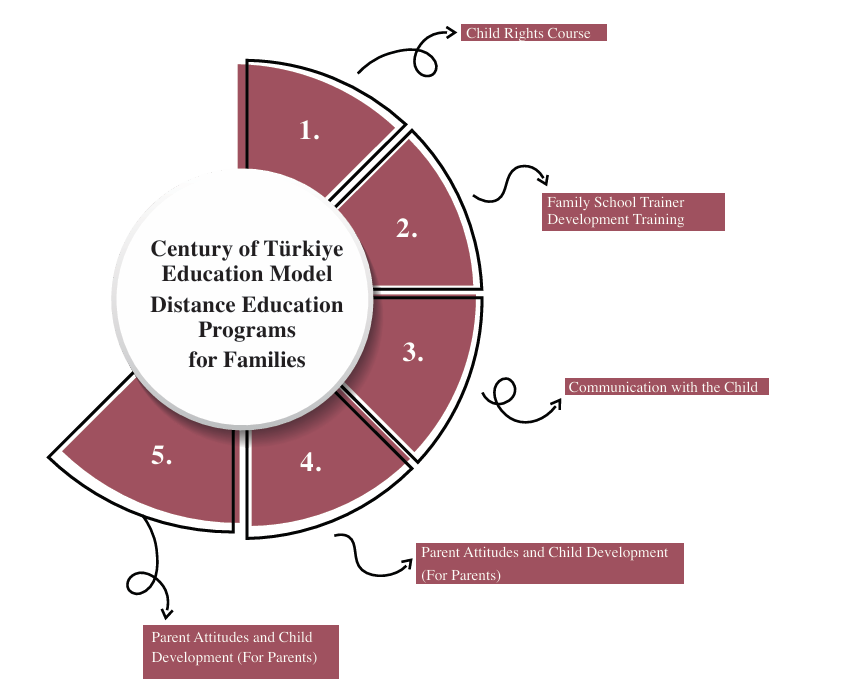
Figure: Century of Türkiye Education Model Distance Education Programs for Families
Velivizyon Platform Series
Parent education content is developed and published on the https://velivizyon.meb.gov.tr/ platform to support parents in raising their children as successful and happy individuals. The active participation of parents in educational processes supports students’ social, emotional and cognitive development and improves their overall school experience. In this context, the Ministry of National Education launched the “Velivizyon” project to strengthen communication between students, parents and schools. The content presented on this platform aims to raise the awareness of families in order to enrich children’s social lives, deepen their world of thought and support their life skills. In addition, the Ministry of National Education the Century of Türkiye Education Model, which has recently been put into practice, aims to enrich education processes with this understanding by considering students holistically with their mental, emotional, physical, social and spiritual development aspects. With this model, it is aimed to raise wise generations who are moral and virtuous and who have adopted the ideal of doing what is good, right, beneficial and beautiful for their nation and humanity.
The Velivizyon platform features “My Family” series of 27 episodes of 10 minutes each with the slogan “Every Family is a School”. The “My Family” series on the Velivizyon platform includes episodes titled “Guiding with Knowledge”, “Accessing the Right Information”, “Being a Guide”, “Loving and Trusting”, “Giving Responsibility”, “Being a Mirror”, “Being an Example”, “Peace at Home Affects Success at School” and “Respect for Teachers”. The series “My Family” on the Velivizyon platform shows that TMM addresses many values and actions related to these values within the framework of “Virtue-Value-Action”. At the same time, the fact that values such as justice, family integrity, diligence, honesty, love, respect, responsibility, thrift and patriotism are covered in the episodes of the series shows that it aims to raise awareness about the importance of these values, especially among families and children. In addition, the series reveals the reflection of the family-child relationship in education through the efforts of families to be role models for their children and to contribute to the strengthening of family relationships. In addition, each episode of the series encourages important actions by parents, such as assigning small tasks and responsibilities to their children and supporting the child’s learning process. The episodes also emphasize kind and understanding behavior among family members, preserving family unity and creating opportunities to spend quality time, eating a balanced and healthy diet, and avoiding waste. Family education bulletins are also published on this platform.
Social Adaptation and Life Education (SLAE) Program
The 8-hour “Social Adaptation and Life Course Program” developed to facilitate the adaptation of all adult foreigners (17-65 years old) with legal residence rights to social, economic and cultural life in our country continues to be implemented through public education centers.
Digital Platforms for the Advanced Technical School for Girls: The Advanced Technical School for Girls Academy
The Advanced Technical School for Girls Academy YouTube channel, which was opened to meet the needs of people who are interested in traditional arts and crafts and who want to train themselves in these fields in order to reach wider audiences faster, includes 50 video content. The focus of the trainings on the channel is the historical process of the concept of design, the place of design today, interviews with artists and experts in their fields within the scope of the future in tradition - tradition in the future, as well as applications for various f ields carried out in the workshops of Advanced Technical School for Girls.
Turkish Language Proficiency Exam (Türkçedil)
The purpose of the Turkish Language Proficiency Exam conducted by the Ministry of National Education the Directorate General of Measurement, Evaluation and Testing Services in e-Sınav centers is to assess the Turkish reading, writing, listening and speaking skills of foreign nationals over the age of 16 who learn Turkish as a foreign language and who want to certify their Turkish language skills in line with their personal development and professional needs. The questions in the exam were developed in accordance with the “Common European Framework of Reference for Languages” and the language proficiencies in the “Programme for Teaching Turkish as a Foreign Language” at the levels of A1, A2, B1, B2, C1.
The exam is conducted entirely electronically in language laboratories and e-Sınav centers designed in accordance with international standards, on computers assigned to the candidate. The Turkish Language Proficiency Test has received the Association of Language Testers in Europe (ALTE) approval (Q-Mark) and has registered its international validity.
ALTE’s Q-Mark approval indicates that the Turkish Language Proficiency Exam has successfully passed ALTE’s rigorous audits and meets 17 quality standards, including test design, administration, logistics processes, grading and classification, test analysis, and communication with stakeholders. Candidates who are successful in the Turkish Language Proficiency Exam are given an internationally valid result certificate.
Reforms in Teacher Training
With the Law No. 7528 on the Teaching Profession enacted in 2024, important reforms were made in the teacher training process in Türkiye. Within the scope of the Law, the duties, rights and responsibilities of teachers and school administrators were defined by taking into account the unique characteristics of educational environments, regulations were made regarding career steps in the teaching profession, and National Education Academy was established.
The duties of National Education Academy can be summarized as preparing and implementing training programs for preparation for the teaching profession, preparing and implementing administrator training programs, preparing, implementing and evaluating training programs for the adaptation of newly appointed teachers to the profession, professional development of teachers, administrators and other personnel, advancement in career steps and promotion in office, and determining their professional competencies. In order to fulfill the duties of the Academy, it is planned to open training and practice centers in many regions of Türkiye.
As of September 1, 2025, those who will be employed as teachers in the Ministry of National Education will be selected from among those who have graduated from at least one of the higher education programs at the undergraduate level that constitute a source for the teaching profession and who are successful in the preparatory training to be given by National Education Academy. Preparatory training will consist of theoretical and practical courses determined within the framework of the teaching profession competencies, including the knowledge, skills, attitudes and values required by the teaching profession. Teacher candidates will be admitted to the preparatory training in line with the results of National Education Academy Entrance Examination (MoNE-AGS). MoNE-AGS will be conducted in 2 sessions: Academy Entrance Examination (AGS) and Field Knowledge of Teaching Test (ÖABT).
The duration of the preparatory education is four semesters. However, this period may be reduced to three semesters depending on the higher education program from which the prospective teacher has graduated. At the end of the preparatory education, 40% of the arithmetic average of the success grades in theoretical courses and 60% of the arithmetic average of the success grades in practical courses will be combined to determine the final success score for the teacher candidates’ appointment.
Teacher candidates who successfully complete the preparatory training will be employed as contract teachers, similar to the current practice in Türkiye. The appointment of contracted teachers will be based on the success score of the preparatory training and will be made in line with the preferences of the teacher candidates. Contracted teachers will not be eligible for reassignment for three years, except for life safety and health excuses. During this period, there will be no candidate teaching process for teachers. Contracted teachers who have completed three years of service will be appointed to teaching positions where they work upon their request. Those who are appointed to teaching positions will not be able to be relocated for one year, except for valid excuses.