

Address
Foundation for the Development of the Education System
Fundacja Rozwoju Systemu Edukacji
Aleje Jerozolimskie 142A
PL-02-305 Warszawa
Tel: +48 664 902 375
E-Mail: eurydice@frse.org.pl
Website
Many concepts and terms related to the adult education policy in Poland may be understood differently, depending on the setting and context where they are used. This refers, in particular, to adult education and training discussed in this chapter. The understanding of the term ‘adult education’ has evolved in the recent decades. Research and policy discourse have used a wide range of terms, including adult education, permanent education, lifelong education, continuing education, and learning in adulthood, to emphasise responsibility and motivation and individualised learning approaches.
Since 2013, efforts have been made to embed in the field of education terms which are convergent with definitions of lifelong learning (UNESCO, OECD and EU documents), including adult education and training. At that time, the Government adopted new strategic documents, ‘The Lifelong Learning Perspective’ (Perspektywa uczenia się przez całe życie) and ‘The Human Capital Development Strategy’ (Strategia Rozwoju Kapitału Ludzkiego), which defined basic policy terms for lifelong learning (LLL).
The key factors in making LLL a reality are skills and conditions and opportunities for skills development as these are necessary for social capital enhancement, economic growth and high quality of life. As a major achievement in devising an integrated skills strategy, which covers the entire education and training system, Poland adopted the ‘Integrated Skills Strategy 2030’ (Zintegrowana Strategia Umiejętności) (ISS 2023), Warsaw, 2020, Ministry of National Education (documents in English: general part and detailed part). The document was developed in close cooperation with all relevant government bodies and stakeholders. This approach was based on the assumption that the relevance of the ISS would largely depend on the involvement of a wide range of stakeholders. Consultations on the ISS 2030 were held at each stage of the development process and involved representatives of several dozen institutions.
Two other documents relevant to adult education in the context of adult skills are: the OECD Skills Strategy Poland: Assessment and Recommendations, OECD Skills Studies (accessed in August 2024) presented in December 2019; and the Integrated Skills Strategy (detailed part) adopted as a public policy by the Government in December 2020. The ISS sets a policy for skills development in line with the idea of LLL, thus referring to the OECD document (accessed in August 2024). The skills development policy is implemented in line with the idea of LLL, which refers to the OECD document (accessed in August 2024). The ISS is also in line with the national development management system, integrating national strategic documents (with regard to skills), namely: the Strategy for Responsible Development to 2020 (with a 2030 perspective) (Strategia na rzecz Odpowiedzialnego Rozwoju), the Lifelong Learning Perspective (2013), and integrated and supra-regional strategies.
Policy documents adopted in Poland and the EU and the national legislation for school education use the following terms relating to adult education and training:
- Continuing education (CE) (kształcenie ustawiczne), defined in the Law on School Education (ustawa Prawo oświatowe) (Article 4, section 30). CE is understood as education / training in schools for adults, stage II sectoral vocational schools and post-secondary schools, and as acquisition of new and supplementary knowledge, skills and vocational / professional qualifications or retraining for new or additional skills or qualifications within the same vocational / professional group in non-school settings for individuals who have completed full-time compulsory education. Education and training in Poland are aimed at the adult population (over the age of 18) of 37.7 million, with the working age population (aged 25 to 64 years) representing 58.71% in 2022 (Central Statistical Office). The European reference group for adult education and training are adults aged 25-64 years who participated in education or training in the four weeks preceding the survey.
- Adult education (AE) (edukacja dorosłych) is used as an equivalent for adult education and training (AET) (kształcenie i szkolenia dorosłych). The scope of AET extends far beyond the fields of school education and higher education and traditional training courses leading to qualifications. AET is also provided as on-the-job practical training or as organised activities of citizens’ groups or communities. There is no comprehensive definition of AET in Poland. This may result, on the one hand, from a vast area it covers, and on the other hand, from difficulties in assigning the responsibility for this type of education and training provision to a single administrative structure.
- Adult learning is understood as learning at the adult life stage, a stage of LLL in various forms and settings (formal, non-formal and informal). In this context, adult learning is part of a sequence of learning activities accompanying the entire life from early years to advanced old age. Skills that individuals possess, develop and acquire play a key role in adult learning understood in this way. In the strategic documents, and in particular the 2030 Integrated Skills Strategy, development of skills (basic, transversal, vocational or professional) is closely linked to LLL in its various (personal, family, social and professional) contexts.
According to EUROSTAT, the AET participation rates for adult Poles have remained below the EU average for many years (see the table below).
|
Adult participation in lifelong learning |
||
|---|---|---|
|
Year |
European Union (27 countries)* |
Poland |
|
2012 |
8.2 |
4.5 |
|
2013 |
9.9 |
4.3 |
|
2014 |
10.1 |
4.0 |
|
2015 |
10.1 |
3.5 |
|
2016 |
10.3 |
3.7 |
|
2017 |
10.4 |
4.0 |
|
2018 |
10.6 |
5.7 |
|
2019 |
10.8 |
4.9 |
|
2020 |
9.1 |
3.8 |
|
2021 |
10.8 |
5.6 |
|
2022 |
11.8 |
7.8 |
|
2023 |
12.8 |
8.7 |
Source: Eurostat (SDG_04_60; data for 11/09/2024), * EU-28 between 2013 and 2019; EU-27 since 2020.
The Eurostat data indicate a steady increase in the proportion of adults participating in education or training during the 4 weeks preceding the survey: the proportion of 8.7% in 2023 was by 5% larger than 5 years ago. The proportion of adults participating in LLL in Poland is still smaller than the average for the 27 Member States of the EU, which has also been steadily increasing. The Eurostat indicator refers to the total population aged 25 to 64 years. Data on the participation in continuing education are more promising for the people employed in enterprises. Findings from the survey published by the Central Statistical Office in 2022 indicate that over 40% of enterprises in Poland provided continuing vocational or professional training in 2020, and the larger the company, the more often it organised training courses. Nearly 29% of the employees of the surveyed companies attended training courses, and on-the-job training was the most common form of education (71.5% of companies) (“Characteristics of continuing vocational training in enterprises in 2020”, Central Statistical Office, 2022).
Interesting data can also be found in the publication “Determinants of learning in adulthood. Report on the Study „Adult Learning in Poland” (M. Petelewicz et al., Uwarunkowania uczenia się w dorosłości. Raport z badania „Uczenie się dorosłych Polaków”, Warsaw, Educational Research Institute, 2023, accessed in August 2024). The report shows that during the 12 months preceding the survey, 2/3 of adult Poles intentionally participated in at least one activity as part of formal or non-formal learning, or workplace learning (excluding compulsory training in health and safety at work). Participation in such forms of learning is higher the lower is the level of its formalisation. Levels of participation in learning in adulthood vary depending on the age, educational attainment, labour market participation and the occupation or profession. Young and better educated people and those in professions requiring specialised skills more often participate in learning. These findings are also corroborated by the results of “The 2022/2021 Study of Human Capital: Report on Employers Survey. Return to reality? The second year of the pandemic in the eyes of Polish companies” (Bilans Kapitału Ludzkiego 2022/2021 – Raport z badania pracodawców. Powrót do rzeczywistości? Drugi rok pandemii oczami polskich firm), and „Competence Development: Adult Learning and the Training and Development Sector” (Rozwój kompetencji – uczenie się dorosłych i sektor szkoleniowo-rozwojowy) (accessed in August 2024).
AET is the most diversified area of education and training in Poland. This is due not only to the diversity of the target groups, their age and social and professional status, forms of education and training, methods for the validation of learning outcomes achieved, in particular, in non-formal and informal learning, but also to the wide range of providers. In identifying AET, all sectors of socio-economic activity (public administration, business entities and non-governmental organisations) should be considered as, unlike in school education, the State does not have a dominating position in AET. With regard to its objectives and organisational form, AET may be divided into formal and non-formal education / learning.
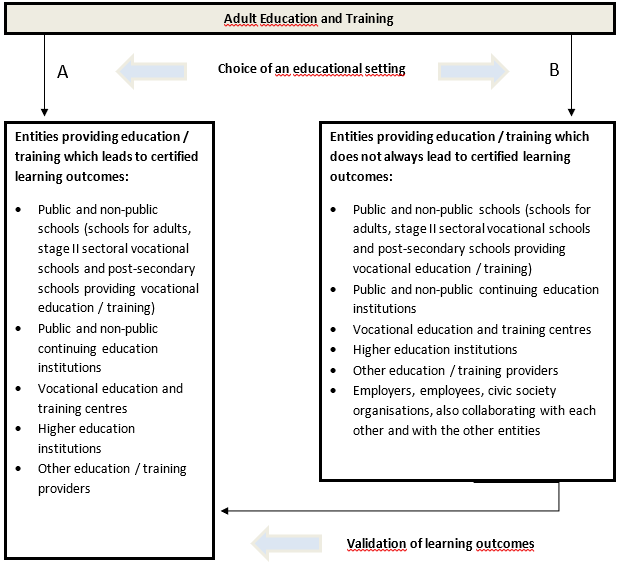
Source: Author’s own elaboration.
The diagram above does not include informal learning as it is not considered as an institutionalised form of adult education and training. Informal learning remains ‘outside’ the diagram, although some of its learning outcomes may be validated and, consequently, become certified learning outcomes, which are increasingly important in adult education. This learning sector forms a whole together with the other sectors of education and training, and learners may attain each qualification level through both formal education and other learning paths.
The provisions in the legislation that came into force in the second half of 2023 (Law on School Education) provided the basis for the establishment and operation of sectoral skills centres (SSCs). This is a new type of public or non-public institution that aims to integrate schools, continuing education institutions, vocational education and training centres, higher education institutions and other entities which are active in a given vocational or professional field. As part of education and training activities, SSCs may administer sectoral vocational schools, provide vocational training sessions to juvenile workers, sectoral training courses and other courses, and conduct vocational exams (see Chapter 8.5, Validation of non-formal and informal learning outcomes).