

Address
Unité nationale d'Eurydice
ANEFORE ASBL
48-50, rue Charles Martel
L-2134 Luxembourg
Tel: +352 247 85284
E-Mail:info@anefore.lu
Website: www.anefore.lu
Geographical accessibility
In general, each pupil attends an elementary school in the municipality where he or she resides. In less populated or rural areas, school transport should be organised by the municipalities. In order to avoid too many journeys, school hours can be adapted by the municipalities.
Admission requirements and choice of school
The passage from pre-school (cycle 1) to primary education (cycles 2-4) happens in direct continuity, and most often within the same elementary school. The transition usually happens at the age of 6, when pupils have acquired the necessary skills and maturity to successfully continue in cycle 2.
Choice of school
Primary education is provided by public elementary schools. Pupils may also attend private or international schools or go to school in another country. In some instances, and subject to the approval of the regional directorate, they may also be taught at home.
Admission procedures vary according to the school where parents wish to enrol their child:
- Automatic admission to a municipal school: The municipality automatically admits its resident children to the school best fitting their place of residence
- Admission to a different school within the same municipality: In case parents wish to enrol their child in another school of the same municipality, they have to submit a written, reasoned request to the College of mayor and aldermen (collège des bourgmestre et échevins)
- Admission to another municipality's elementary school: If parents wish to enrol their child in another another municipality's elementary school, they have to submit a reasoned request to that municipality's College of mayor and aldermen. This has to be done before 1 May of the preceding school year. The parents also have to prove valid grounds, such as:
- Custody of the child by a family member
- Custody of the child by a third person (State-approved day-care family)
- Custody of the child by a socio-educational body approved by the State
- Work place of a parent.
- Admission to a private, international or European school: Parents may also enrol their child in a private, international, European or foreign school; they have to inform their municipality of their decision, within the period of notice prescribed by the law (see below).
Admission is usually done at the beginning of the school year. Some municipalities also accept later registration at the beginning of the 2nd or 3rd term. Parents of children attending a school outside their commune of residence have to inform their municipality at least 8 days before the school start, submitting a copy of the children's registration certificate. Parents who wish to provide home education to their children have to make a statement to their municipality.
According to their age, foreign children newly arrived in Luxembourg are integrated in elementary school cycle 1, where they learn Luxembourgish, or in cycles 2 to 4, where they learn Luxembourgish, German and French. Depending on their mother tongue and prior knowledge, they receive additional welcome lessons (cours d'accueil) in German and/or French (see Eurydice article 12.3 - Support measures for learners in early childhood and school education).
Age levels and grouping of pupils
Age levels
Elementary education is organised in 4 learning cycles. Cycles 2 to 4 correspond to primary education. They have a standard duration of two years each.
Typical age levels are, at the beginning of the school year:
- Cycle 2: children aged 6-7 years
- Cycle 3: children aged 8-9 years
- Cycle 4: children aged 10-11 years.
Pupils progress from one cycle to the next once they have developed the necessary skills set as standards for progression at the end of their cycle. If a pupil has not been able to develop the necessary competences within two years, the pedagogical team of the cycle establishes a one-year programme adapted specifically to this child’s needs, thus allowing the pupil to go on to the next cycle after a third year.
Teachers
In general, each class has a class teacher (titulaire de classe) who accompanies the pupils throughout a learning cycle. The teachers of classes in a given cycle work as a pedagogical team.
Classroom size
The laws on elementary education do not state any minimum or maximum class size. Within their cooperation as pedagogical teams, teachers of a cycle have a certain flexibility regarding the organisation of lessons.
However, the calculation of the contingent of lessons is based on an average class size of 16 pupils. The contingent had been introduced in 2010/11. Teachers are employed by the State and assigned to the different schools according to the contingent established for each school.
In 2020/21, the average group size was 15.1 pupils per class (MENJE (SCRIPT), 2022).
Organisation of the school year
The academic year is divided into three three-month terms.
Elementary schools have to be open during the school year, that is 36 weeks per year. They are not obliged to stay open during holiday periods.
School holidays are defined by grand-ducal regulation (règlement grand-ducal du 2 septembre 2020 fixant les calendriers des vacances et congés scolaires pour les années scolaires 2020/2021, 2021/2022 et 2022/2023).
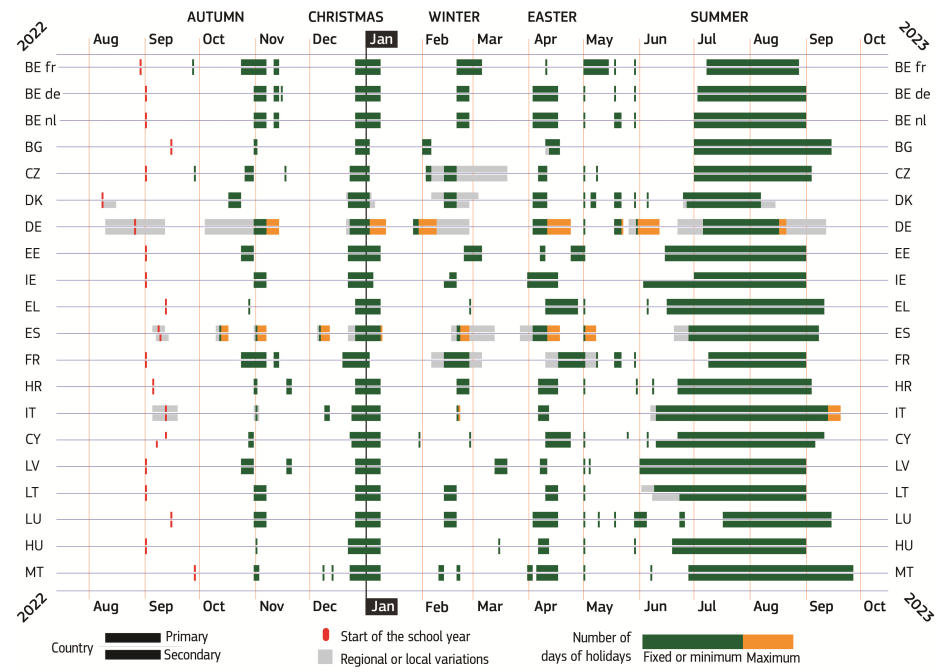
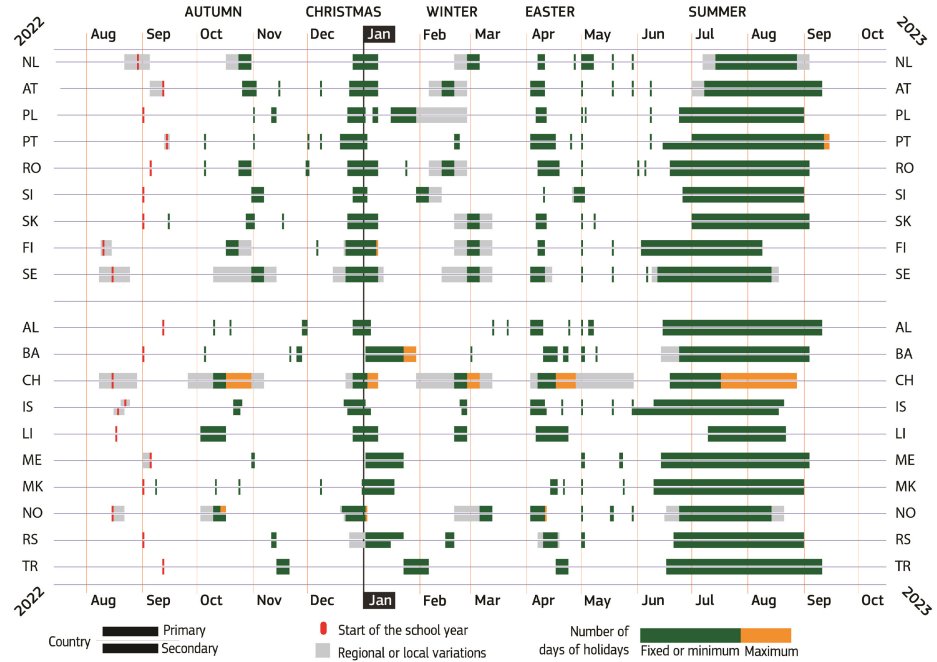
The following figures provide an overview of the school year 2022/23:
Number of weekly lessons
The annex of the grand-ducal regulation setting the curriculum framework for elementary education (règlement grand-ducal modifié du 11 août 2011) prescribes a number of 28 lessons per week and 1 008 lessons per year to be held in cycles 2, 3 and 4 of elementary education. The number of lessons dedicated to the various subjects differs from cycle to cycle.
According to the grand-ducal regulation on the mission of elementary school teachers (règlement grand-ducal du 23 mars 2009), a school lesson lasts 55 minutes. It may be reduced to 50 minutes for organisational reasons.
Organisation of the school day and week
Timetables
Within the regulatory framework described above, municipalities have the autonomy to determine their elementary schools’ timetables.
In most municipalities, elementary schools are closed on Saturday. On Tuesdays and Thursdays, there are no classes in the afternoon. A majority of the municipalities has adapted a weekly timetable which corresponds more or less to the following model:
| Monday | Tuesday | Wednesday | Thursday | Friday |
| 8 a.m. - 12 p.m. | 8 a.m. - 12 p.m. | 8 a.m. - 12 p.m. | 8 a.m. - 12 p.m. | 8 a.m. - 12 p.m. |
| 2 p.m. - 4 p.m. | 2 p.m. - 4 p.m. | 2 p.m. - 4 p.m. |
Out-of-school-hours provision
Since 2012 (règlement grand-ducal du 16 mars 2012), municipalities are obliged to set up a Plan for Extracurricular Education (PEP; plan d’encadrement périscolaire), which includes all local formal and non-formal activities proposed to school-aged children (cultural activities, sports, learning, meals, ...) and shows the comprehensive offer on a daily and weekly basis.
Extracurricular education (encadrement périscolaire) has to be organised by the schools and by accredited socio-educational institutions. The hours for which extracurricular childcare is proposed are defined at community level, within the PEPs.