

Address
Hungarian Eurydice Unit
Educational Authority
19-21 Maros utca
Room 517
HU-1122 Budapest
Tel: +36 20 931 20 10
E-Mail: eurydice@oh.gov.hu
Website
Place guarantee to ECEC
Access to nursery care
In Hungary, the care of young children has traditionally been provided by mothers within the home, as family support benefits allow parents to stay at home with their children until the age of 3.
In recent years, a number of changes have taken place in the legislative environment in order to improve access to nursery and kindergarten services. Since 2017, it has been a mandatory task of local municipalities to provide nursery care in any settlement where more than 40 children under the age of 3 reside, or where at least 5 children are registered by parents as requiring such care. The use of nursery care is not compulsory; rather, it serves as an option available to parents.
The establishment of new institutions, the expansion of nursery places, and the growing availability of funding opportunities have significantly increased the available capacity.
Local municipalities may operate nurseries, mini-nurseries, family nurseries, or workplace nurseries, either independently, in cooperation with another municipality, or through a service provision contract concluded with a non-state provider (civil or church-based).
If a local municipality does not provide nursery care yet:
-
by 1 March each year, it must publish a notice—through the locally customary means—informing parents or other legal guardians that they may indicate their demand for nursery care to the municipality by 15 April; and
-
by 31 March each year, it must examine whether, based on data from the Hungarian Central Statistical Office as of 1 January of the given year, the number of residents under the age of 3 in the settlement exceeds 40.
In Hungary, the expansion of nursery capacity is financed through domestic and European Union development funds.
|
|
Number of institutions | Number of available places | Number of children enrolled | |||
|
Type of care |
2017 |
2024 |
2017 |
2024 |
2017 |
2024 |
|
Nursery a) |
754 |
1 221 |
40.040 |
55 214 |
37.977 |
49 640 |
|
Mini nursery |
50 |
508 |
354 |
4 765 |
346 |
4 435 |
|
Family nursery c) |
938 |
1 235 |
6.032 |
8 547 |
5.732 |
8 109 |
|
Workplace nursery b) |
7 |
26 |
49 |
302 |
38 |
240 |
|
Total |
2 990 |
46.475 |
68 828 |
44.093 |
62 424 |
|
a) Group size of 6–14 children
b) Group size of 3–8 children
c) Group size of 2–8 children
Source: Hungarian Central Statistical Office
National development policies and the government continue to focus on expanding capacity and developing infrastructure in order to make access to services more territorially balanced.
The improvements observed in recent years in nationwide coverage and in the utilization of institutions are also reflected in reduced territorial inequalities and improved access to services.
| Number and proportion of children under the age of 3 who do not have access to daytime care at their place of residence |

|
Source: Hungarian Central Statistical Office
Access to kindergartens
Attending kindergarten is compulsory from the age of 3 years.
The provision of kindergarten education is mandatory for all local governments. Local governments include local governments of towns with county rights, local governments of towns and local governments in the districts of Budapest. In every settlement where at least eight preschool-aged children are resident and, on the basis of demographic data, it is assumed that this will remain the case for at least 3 years, the local government must provide a local kindergarten, if requested by at least eight of the parents concerned. Local governments must also ensure that children of ethnic minorities attend kindergarten, as well as children with special educational needs, who can be cared for also in an integrated manner.
Kindergartens may be established and maintained by the state, minority self-governments, local governments and ecclesiastical legal persons registered in Hungary, and by other organisations and persons if they have acquired the right to provide this service in accordance with the provisions of the law.
In state and municipal institutions, as well as in other institutions providing childcare on behalf of the state, the use of kindergarten education and additional pedagogical services is, in almost all cases, free of charge for children.
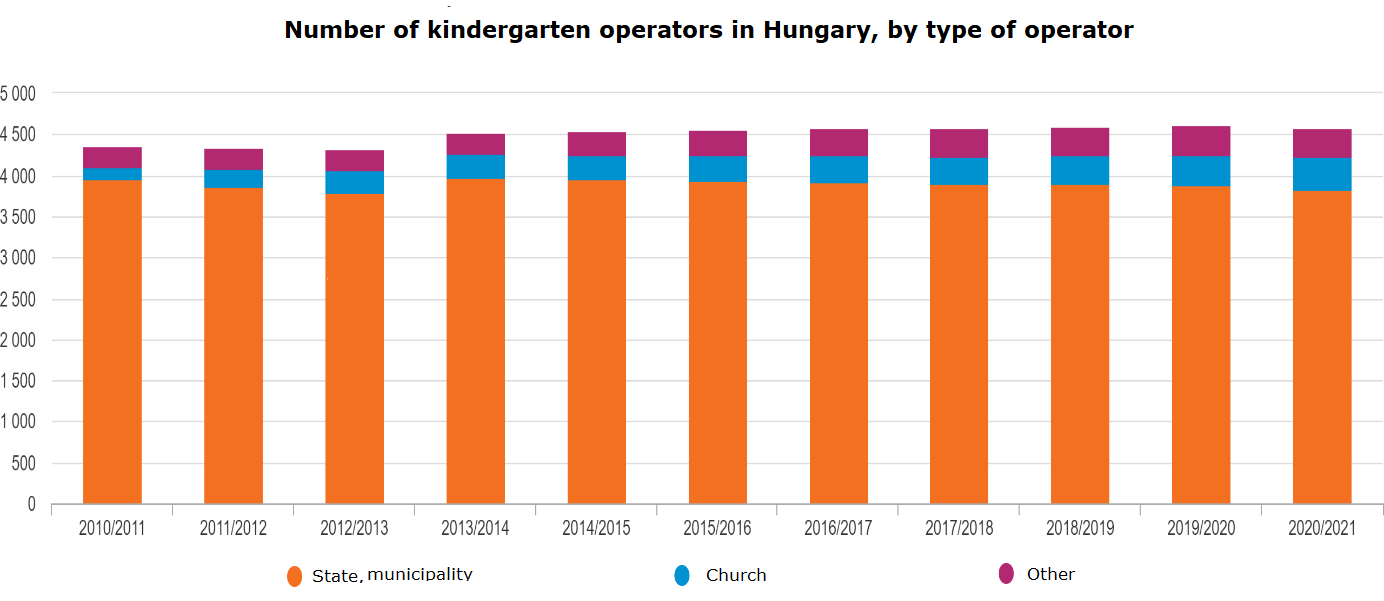
Most of the institutions are maintained by local governments. Nearly 15 % of institutions are operated by churches or foundations (or other). Only 4% of kindergartens are maintained by a foundation or a private entity; some of these operate on a for-profit basis.
Kindergarten education for young children took place in 4575 kindergarten sites in the 2020/2021 school year, which is a 5.0% increase in the last 10 years. The majority of kindergartens, almost 84%, are run by local/district governments or by public operators. The number of church-run kindergartens has grown the most dynamically among kindergarten sites. Their proportion has been steadily rising since 2010, and now kindergartens run by church organizations account for 8.8% of all the institutions
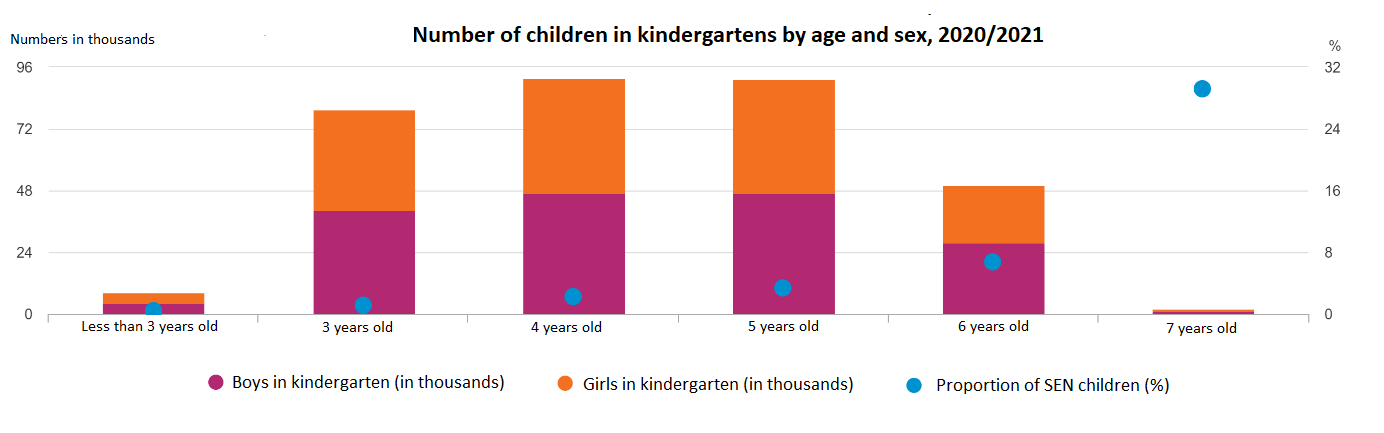
The number of children in kindergarten is approximately 318,000, which is 4,000 fewer than in the previous year. The upward trend from 2016 stopped in 2020, partly due to a moderating increase in the age group concerned and partly due to the increasing enrolment of six-year-olds in primary school.
The number of kindergarten teachers continued to decrease, by a total of 200 compared to last year. At the same time, the number of places has increased, mainly due to new church-run institutions. The average number of children per teacher has improved by 2 percentage points, but there are still slightly more than 10 children for 1 teacher.
The extent of the decrease was almost the same in the case of state, municipal and church-run kindergartens, but the average group size remained 18 in kindergartens operated by foundations and other organizations.
All institutions providing public kindergarten education, regardless of their operator, are subject to the same legislation. Therefore, equality of care is ensured. In addition, the right to establish an institution can be widely exercised.
Kindergartens can also operate as part of so-called multipurpose institutions. In such cases, the kindergarten operator organises the tasks of several types of public education institutions integrated into one institution; non-public education tasks may also be integrated into the institution.
As regards compulsory preschool education, in the year in which a child reaches the age of 3 years by 31 August, they must attend kindergarten for at least 4 hours a day from the beginning of the school year. At the request of the parent, which must be submitted by 25 May of the current year, the body designated by government decree may exempt the child from attending kindergarten, until 31 August of the year in which the child reaches the age of 4 years, if it is in the best interests of the child and if the child’s family circumstances and special situation justify it.
Affordability
Nursery institutions
Based on the provisions set out in the relevant legislation (Child Protection Act – Gyvt.), fees must be paid for nursery care services and for children’s meals.
In the case of nurseries and mini-nurseries, the fee payable by parents consists of two components:
-
a fee for the care and education of the child, and
-
a fee for meals.
Care fee
As a result of the regulatory framework—if the maintainer decides to charge a fee—it must be determined on the basis of the income situation of parents. The head of the institution determines the amount of the fee based on the family’s regular monthly per capita income, using the income declaration completed by the parent; thus, the principle of need-based support applies.
When calculating the monthly per capita income, the income of the following individuals must be taken into account:
-
the parent and the parent’s spouse or partner;
-
a child under the age of 20 who does not have an independent income;
-
a child under the age of 23 who does not have an independent income and is pursuing studies in full-time education;
-
a child under the age of 25 who does not have an independent income and is pursuing studies in full-time higher education;
-
a child with a long-term illness or a disability, regardless of age;
-
a relative not listed above who is supported by the parent or the parent’s spouse in accordance with the relevant family law provisions of the Civil Code.
Exemptions from the payment of the care fee in nursery institutions
In nursery institutions, the following are exempt from paying the care fee:
-
children receiving regular child protection benefits;
-
children from families with three or more children;
-
children who are chronically ill or have disabilities;
-
children in temporary care, placed with foster parents under temporary guardianship or in children’s homes, as well as children taken into care;
-
children under child protection supervision.
Information and assistance regarding discounts, entitlements, and other available options are provided by the social services department of the local municipality.
In many municipalities, services are completely free of charge, as maintainers may decide to waive the payment of fees.
The personal fee is an individualized fee calculated from the institutional fee, determined by taking into account the individual social and income circumstances of the child, as well as applicable discounts.
Fee payable for meals
Children enrolled in nurseries and mini-nurseries receive institutional catering, which is an in-kind benefit forming part of the child protection system and is a mandatory task of local municipalities. Nursery children are provided with four meals per day.
The following children are entitled to free institutional meals:
-
children receiving regular child protection benefits;
-
children who are chronically ill or have disabilities, or who live in families raising a chronically ill or disabled child;
-
children living in families with three or more children;
-
children whose family’s per capita net monthly income does not exceed 130% of the net amount of the statutory minimum wage (EUR 658);
-
children taken into care.
These grounds for exemption must be certified by the parent in a written declaration using a standard form.
Under the provisions of the law, the total amount of the personal nursery fee, including meals, may not exceed 25% of the family’s per capita net income; without meals, it may not exceed 20%.
In nurseries and mini-nurseries, families pay an average monthly amount of EUR 31,4 for meals and—where a care fee is charged—an average of EUR 49,7 per month for care.
Approximately 67% of children attending nursery institutions receive meals free of charge.
Kindergarten care
Kindergarten education is part of public education, so it is mainly financed from the state budget. Kindergarten care and participation in public education are free. The funding system is two-tiered: the majority of the central budget support is given to operators, who determine the expenses of their respective kindergartens as part of their own budget. Thus, the resources required for kindergarten operation are provided jointly by the state budget and the operator. Funding can be supplemented by fees paid by parents for complementary services used by children, such as school meals, and other public education institution revenues.
Unless otherwise specified by the parent, children have lunch and two additional meals (morning and afternoon snacks) in the kindergarten on school days. If the local government is responsible for providing the meals, the fee paid by parents for meals is determined by the local government.
As regards further services, in micro-villages and farms, kindergarten associations (i.e. several settlements operating a joint kindergarten) are not uncommon and a kindergarten bus transports children.