

Address
Hungarian Eurydice Unit
Educational Authority
19-21 Maros utca
Room 517
HU-1122 Budapest
Tel: +36 20 931 20 10
E-Mail: eurydice@oh.gov.hu
Website
Steering documents
Nursery care
The conditions and detailed professional aspects of nursery care and education are provided in the Core Programme.
The Core Programme aims to provide a framework for the professional work conducted in nursery institutions and services in Hungary. Its content and approach are in line with The Fundamental Law of Hungary, the legislation governing the care and education of children under 3, the traditions and accumulated values of nursery education, national characteristics, and the latest early childhood research findings.
The chapters of the Core Programme apply to all forms of nursery care (nursery, mini-nursery, workplace nursery, family nursery), taking into account the specifics of each care form.
According to the Core Program, the principles of nursery education and care are:
-
A systemic approach to the family;
-
Adoption of an early childhood intervention perspective;
-
Respect for primary family education;
-
Respect for the child’s personality;
-
The significant role of the nursery caregiver’s personality;
-
Creation of security and stability;
-
Gradualness;
-
Individualized approach;
-
The importance of caregiving situations;
-
Supporting the child’s competency development.
Tasks of nursery education and care:
-
Support families by building on their strengths and developing parental competence;
-
Protect health and establish a foundation for a healthy lifestyle;
-
Develop emotional and social competencies;
-
Support the development of cognitive processes.
Institutions develop their own pedagogical programmes while adhering to the principles of the Core Programme.
Kindergartens
The binding document setting out requirements on the content of kindergarten education is the national core programme of kindergarten education (Óvodai nevelés országos alapprogramja) It is valid for all kindergartens regardless of the operator. This core programme is a framework-type regulator; it formulates the government’s expectations for kindergarten education by providing guidelines, main tasks, organisational frameworks and activities. On the basis of the core programme, kindergartens prepare their individual pedagogical programmes at institutional level; these regulate, in detail, the activities and methodological directions of the given kindergarten, as well as the rules and timeline for documenting the pedagogical work. The pedagogical programme is prepared by the kindergarten’s early childhood education and care staff and the method of approval depends on the operator. In the case of a kindergarten operated by a local government, the head of the kindergarten is the approver; the consent of the operator is required only in the case of additional costs. In the case of church-run institutions, the operator approves the pedagogical programme of the kindergarten. The pedagogical programme must not be in conflict with the national core programme of kindergarten education, and this is ensured by multiple levels of control. The law stipulates that kindergarten teachers can plan the methodology of their group’s activities based on this pedagogical programme but that the methodology should be differentiated according to each child’s individual development plan. The central regulation highlights both the child’s individual development plan (differentiation) and the kindergarten teacher’s professional activity (portfolio). This process (the core programme, the institutional pedagogical programme, the individual children’s development plans and the teachers’ portfolios) ensures the consistency of regulated common content in kindergarten education and the diversity of local needs.
Stages of pedagogical programme planning
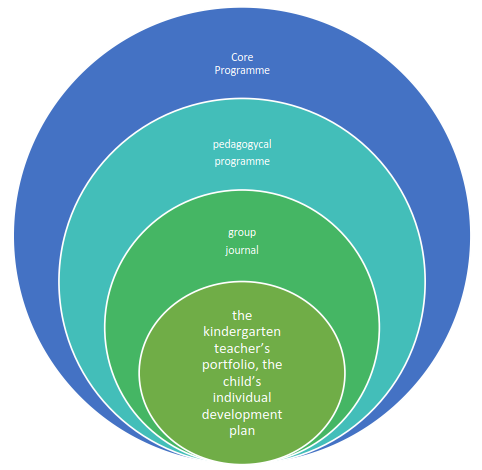
Educational tasks and methods
According to the national core programme of kindergarten education, various pedagogical aspirations, including innovative ones, may be incorporated into kindergarten education, as the core programme ensures freedom regarding the pedagogical views, values and methodologies of kindergarten teachers, and sets restrictions only in respect of the protection of the child’s best interests.
Areas of learning and development
Nursery care
The tasks of nursery education and care are defined by the Core Programme (A Bölcsődei Nevelés-gondozás Országos Alapprogramja).
Learning
Early childhood learning occurs in natural life situations: care, play, joint activities, and communication with adults and peers. Learning includes any process of gaining experience or information that brings about lasting changes in behaviour or thinking, helping the child understand themselves and their environment. Learning is embedded in age-appropriate and developmentally suitable activities.
Care
Care is an intimate interaction between the nursery caregiver and the child, primarily aimed at fully meeting the child’s physical needs. The quality of care significantly influences habit formation and the child’s process of independence.
Play
Play is the most important activity of childhood. It helps children understand and engage with the world, supporting physical, cognitive, emotional, and social development. Play provides opportunities for forming social relationships, experiencing joy, and learning from peers.
Physical activity
Infancy and early childhood are periods of fundamental movement development. Children have a strong need for movement, which is a source of joy. Indoor and outdoor spaces should allow for ample movement and developmental play. Supporting independence includes allowing active participation in care tasks, promoting the practice and refinement of practical movements.
Rhymes and songs
Nurseries provide diverse musical experiences through environmental sounds, the caregiver’s voice, spontaneous humming, rhythmical speech, listening to and playing instruments, and communal singing. These activities support language and musical development, personality growth, emotional well-being, and a cheerful group atmosphere.
Poems and stories
Poems and stories strongly influence emotional, cognitive, and social development. Rhythm and content affect the child’s personality. Both folk and literary works are included in nursery programmes.
Creative activities
The joy is in the activity itself – expressing emotions, creativity, and self-expression – not in the result. Common creative activities include imprinting tools, scribbling, clay modelling, gluing, crumpling, tearing, finger painting, and painting with thick brushes.
Other activities
These relate to preparing for and addressing life situations, exploring the environment, and caring for each other (e.g., bathing dolls, watering plants, raking leaves, baking, making fruit salad). Joy comes from the “I did it” experience, teamwork, and recognizing the importance and usefulness of activities.
Kindergartens
According to the national core programme of kindergarten education (Óvodai nevelés országos alapprogramja), the main principles in kindergarten education are:
-
the child’s personality is accepted, respected, loved, cherished and trusted;
-
education promotes and supports the child’s personal development and the development of the child’s individual skills and abilities;
-
the pedagogical methods used in kindergarten education should be tailored to the child’s personality.
The task of kindergarten education is to meet the physical and mental needs of the child, including:
-
learning to lead a healthy lifestyle;
-
emotional, moral and value-oriented community education;
-
intellectual and mother tongue development and education.
Kindergarten education aims to enable children to reach the physical, mental and social maturity necessary to start primary school education by the end of the kindergarten programme. The expected outcomes are as follows.
-
A physically healthy child is able to move more harmoniously and in a more coordinated way by the end of kindergarten. The child is able to intentionally control their movement, behaviour and the satisfaction of their physical needs.
-
A mentally healthy child is ready to go to school with an open attitude at the end of kindergarten. The child’s learning skills mean that they are ready to start school. In addition to involuntary memory and recall, intentional memory and recall improve. The intentional attention that underlies learning emerges, and elementary conceptual thinking also emerges. Of particular importance is the development of spatial perception, visual and acoustic differentiation, spatial awareness, spatial movement development and the formation of the body schema.
-
By the end of kindergarten, children are socially mature enough for school. A socially mature child can adapt to an increasing number of rules and defer gratification. Their task consciousness is developing, and it is manifested in their understanding of tasks, focus on tasks and increasingly effective performance of tasks. The development of their perseverance, pace of work, independence and self-discipline supports them.
Kindergarten activities and the tasks of the kindergarten practitioner are as follows.
Poems and stories. Kindergarten education is expected to provide alternative opportunities for children’s self-expression in activities, and it is expected that folk, classical and contemporary literature are introduced to children. Rhymes, humming and poems, which are mostly combined with playful movements, contribute to the child’s emotional security and mother tongue education. Stories are particularly suitable for shaping the child’s attitude and their view of the world. This area acknowledges the anxieties of the child and at the same time it offers a resolution and a solution. The creation of their own poems and stories, combined with movement and/or representation, is a way for children to express themselves. Daily storytelling, rhymes and verses are vital for the child’s mental hygiene. In kindergartens, folk, classical and contemporary literary works are offered.
Singing, music and games with songs. Musical folk games and a sophisticated selection of contemporary works of art serve as an important tool in shaping a child’s musical abilities (rhythm, singing, listening, movement) and musical creativity. When choosing music to listen to, the kindergarten teacher is expected to consider the children’s national or ethnic affiliation. In kindergarten, observing the sounds of the environment, certain sitting games children’s folk songs, singing and playing games alongside singing and music gives joy to the children, and at the same time these activities stimulate musical interest and shape their musical taste and aesthetic receptivity. During the singing and musical activities, the child discovers the beauty of melody, rhythm and movement, and the joy of singing together. Singing and listening to folk songs, folk dances and folk games help children to get to know traditions and keep them alive. Successful kindergarten singing and music education establishes and promotes the development of the musical mother tongue.
Drawing, modelling and arts and crafts. Drawing, painting, modelling, building, making pictures and handicrafts as different types of representation, as well as getting to know works of art, folk art and the aesthetic environment, are important tools for the development of a child’s personality. The task of the kindergarten teacher is to acquaint the children with the use of artistic tools, various materials, and basic elements of and procedures for drawing, painting, modelling and handicrafts. The kindergarten teacher provides space and various tools for activities related to arts and crafts throughout the day.
Physical exercise. In accordance with the principles of kindergarten education, special attention is paid to the planning, organisation and provision of daily physical education. Regular healthy exercise, games and tasks adapted to children’s level of development are means of establishing, shaping and developing psychomotoric skills and abilities. Games, activities and tasks incorporating movement have a positive effect on the development of strength and endurance, which support stamina and the healthy development of the children’s bodies. Spontaneous, free-play physical activities are complemented by controlled activities encouraging movement. Kindergartens encourage cooperative movement games, which are particularly useful for children’s development.
During kindergarten education, children belonging to a national minority must be given the chance to be able to conserve, preserve, strengthen and convey their identity, and must be guaranteed the opportunity for multicultural education based on integration. Children of families that were forced to leave their home countries (migrants) must be given the chance to be able to conserve, preserve, strengthen and convey their identity and social integrity.
Pedagogical approaches
Nursery care
A systemic approach to the family means the primary focus in nursery education is understanding family functioning. A systemic view considers both the child and family as central. Interaction patterns reflected by the child reveal family strengths and weaknesses. Emphasizing strengths can improve family quality of life.
Early childhood intervention includes any activity aimed at identifying and addressing the child’s specific needs. Nursery institutions are suitable environments for applying this approach. Caregivers are responsible for identifying and reporting any developmental delays or concerns.
Child-rearing is the family’s right and responsibility. Nurseries respect and strengthen family values, traditions, and customs while participating in the child’s education. Parents should be enabled to actively participate in nursery life in various ways.
The caregiver’s role is crucial, influencing both the child and family. Adequate professional competence, self-awareness, social skills, and identity are essential. The orientation/adaptation period helps restore the child’s sense of security. Consistent personal and material environment increases emotional security and supports habit formation. Continuity and predictability in the daily schedule enhance stability and security. Safety includes protection from physical and psychological harm. The caregiver is responsible for maintaining and developing their professional knowledge and competencies.
Kindergartens
The national core programme of kindergarten education (Óvodai nevelés országos alapprogramja) defines the followings:
When defining the pedagogical principle of kindergarten education, the followings must be essential:
-
the child, as a developing entity, is entitled to loving care and special protection
-
educating the child is primarily the right and duty of the family, kindergartens have a complementary or sometimes a compensatory role therein;
-
kindergarten education must encourage the full development of the child's personality, with respect for human rights and the rights of the child, and to ensure that all children have equal opportunities to benefit from a quality education.
According to the national core programme of kindergarten education, kindergarten education may include a variety of pedagogical approaches, including innovative ones. It ensures that the pedagogical views, values and the methodological freedom of kindergarten teachers are respected, and contains restrictions only to protect the rights of the child.
According to the core programme, the main principles in kindergarten education are that:
-
the child’s personality is accepted, respected, loved, cherished, and trusted.
-
education promotes and supports the child's personal development, the development of the child's individual skills and abilities.
-
the pedagogical methods used in kindergarten education should be tailored to the child’s personality.
In order to implement the principles, kindergarten education ensures:
-
that the needs of the child are fulfilled, and a cheerful, loving and emotionally secure atmosphere is created;
-
that the individual and age-specific development of the child’s physical, social and intellectual skills is provided;
-
a rich variety of (age- and development-related) activities in the community, with a particular attention to play, which cannot be replaced with any other activity; and through these activities, the teaching of cultural contents and human values; and
-
the personal and physical environment necessary for the child’s healthy development.
Assessment
Nursery care
Nurseries keep documentation to monitor child development, guided by methodological recommendations. The Methodological Guide (published by the Hungarian Nursery Association) supports caregivers in documenting professional observations.
Care is based on observing the child. Observations document knowledge of developmental stages, guiding individualized education and development plans. Documentation supports systemic family approaches and effective communication.
Key records include:
-
Health record: documents the child’s health, including medical history, initial status, and nursery development, supplemented by a developmental sheet.
-
Communication notebook: for parent-caregiver communication, includes child and parent data, medication, and food sensitivities.
-
Developmental diary: tracks the child’s personality and skill development, supporting individualized care and regular communication with parents. Records are retained for 15 years.
-
Group diary: mandatory for all nursery groups, maintained by both caregivers and assistants, documenting children’s physical, emotional, and social development, attendance, daily meals, events, and other relevant occurrences.
Continuous observations support identifying individual and group needs, implementing personalized approaches, prevention, correction if needed, and ongoing communication with parents. Early detection of developmental difficulties enhances early intervention.
Kindergartens
Documentation monitoring the child’s development is a report, that includes the child’s level and progress of development, and the direction of differentiated education. It includes the child’s medical history, the indicators of the child’s intellectual, psychological, social and physical development, as well as the findings and measures taken to support their development and the achievements made. If an expert committee has assessed the child, it should include the findings of the assessment, the recommendations of the development teacher,
In Hungary, the monitoring of kindergarten children's development and informing parents regularly is regulated by a ministerial decree (48/2012. (XII. 12.) EMMI rendelet), that means that early diagnosis based on teacher observation and anamnesis is possible for all children from the age of 3.
There is no standard, mandatory template for documenting kindergarten children's development, but several templates are available and creating a personalised version is also possible. This has allowed the creation and dissemination of innovative good practices, as well as the possibility of corrections, for example in the definition of monitoring criteria.
The Diagnostic System for Assessing Development (A Diagnosztikus fejlődésvizsgáló rendszerről) is a method/tool recommended for examining development, which is available to kindergartens as well as schools. It is an assessment tool suitable for assessing basic skills that are critical for progress (writing coordination, listening, relational vocabulary, basic numeracy, empirical inference, empirical understanding, social development).
The system allows the detailed monitoring of the acquisition of these critical basic skills for children aged 4–8 years using the so-called development indicator. This assessment tool also describes the acquisition processes of these skills and highlights the opportunities and tasks for more effective development. By applying the system, so-called criterion-oriented skills development becomes feasible (i.e. the individual development of the children lasts until the critical basic skill in question is functioning optimally).
Every kindergarten records the indicators of child development, such as the results of the assessment of speech, hearing, vision, mental and movement abilities, as needed, at least every 6 months. Measures, findings and suggestions regarding the development of the child should also be recorded. The kindergarten teacher informs the parents of the child’s development on a regular basis. The aspects of development that are typically recorded in development journals include the following.
As required, the pedagogical expert committees are responsible for the examination of children’s abilities in order to identify special educational needs and disabilities. In order to monitor the services, an integrated monitoring system (Integrált nyomonkövető rendszer) has been applied since 2015 for children eligible for early childhood development support. An integrated follow-up system makes it possible to keep track of all expert pedagogical services received by the child (all forms of care) and ensures the transparency of the child’s development path (i.e. changes). The advantage of the system is that the child’s development path can be monitored, even in the case of a change of educational institution.
Transition to primary school
Support for the transition from kindergarten to school (Az óvoda és az iskola közötti átmenet problémáinak oldása) has long been a focus of Hungarian public education, and has been partly funded by EU projects.
Facilitating this transition and making it as problem-free as possible is a priority for both kindergarten teachers and primary school teachers. Several projects and studies (e.g. Kende and Illés (2007), Golyán (2013) and Nagy (2018)) deal with this topic. The range of collaborations, joint projects and initiatives is expanding.
A recurring topic of Hungarian central (national- and regional-level) and local (institutional-level) incentives, continuing professional development training for teachers and professional forums is the harmonisation of the pedagogy of interinstitutional transition. Good practices and the development of innovations have begun to be shared, and several EU projects have been planned to coordinate the pedagogical toolkit in the field of kindergarten–school transition, including projects implemented in the educational authority (EFOP-3.1.1, EFOP-3.1.5, EFOP-3.2.15 Emberi Erőforrás Fejlesztési Operatív Program (EFOP) - Human Resources Development Operational Programme).