

Address
Unité francophone d'Eurydice
Administration Générale de l’Enseignement
Ministère de la Fédération Wallonie-Bruxelles
(bureau 3P25)
Avenue du Port, 16
BE-1080 Bruxelles
Tel: +32 2 413 29 68
E-Mail: eurydice@cfwb.be
Website
Responsible bodies
Non-school childcare facilities
The decree of 17 July 2002, the decree of 21 Februar 2019 aiming at strenghtening the quality and accessibility of early childhood care in the French Community and its decrees 5 May 2004, 2 and 22 May 2019 define the role of the Office for Birth and Childhood (ONE : Office de la naissance et de l’enfance) and its responsibilities regarding the evaluation of the quality of collective and family-based childcare facilities. ONE has appointed :
- childcare coordinators and advisers who analyse and evaluate the appropriateness and feasibility of plans for new childcare facilities ;
- subregional committees, which have the power to grant, refuse, withdraw and if necessary suspend a childcare facility’s authorisation ;
- educational advisers who work to improve the quality of childcare and support the professionals.
Pre-primary, primary and secondary education
General context
Article 24 of the Belgian Constitution (1831) provides for freedom of education. In 1959, a fundamental law called the Schools Pact (law of 29 May 1959) organised and normalised relations between the networks and safeguarded the genuine exercise of families’ freedom of choice. Since then, any provisions which have been likely to reduce the autonomy of the controlling authorities have been the subject of negotiations, and are predicated on the preservation of a balance between the various parties’ rights and obligations. Although they existed previously, quality evaluation schemes have been the subject of legislative measures in recent years that have reinforced their role by defining their missions and specifying some of the ways in which they work.
The starting-point for this development was the adoption of the Decree on the Missions of Schools (24 July 1997). This defines the goals that all pupils in compulsory education are supposed to attain, makes provision for the preparation of skills guidelines and creates an initial steering scheme.
In 2002, the education system’s steering mechanism was reinforced (decree of 27 March 2002). The aim of this mechanism is to increase the coherence of education in the French Community and improve the quality of the education system, in particular by the establishment of a Steering Committee. A public-interest body with a legal personality, the ‘Public Enterprise for New Information and Communication Technologies’ (ETNIC), was created. This body is responsible among other things for establishing and updating a database and for introducing a research and statistical service. Teachers’ in-service training was regulated, and an Institute for In-Career Training (IFC) was set up: the IFC now organises inter-network in-service training, in particular for inspectors and school heads (decrees of 11 July 2002).
In 2006, the scheme for external non-certificative assessments was reinforced and reorganised. The award of the certificate of primary education (CEB) was regulated: the role of an external assessment test in the award of this certificate was defined. A framework was provided for the organisation of a common external test at the end of the first stage of secondary education. A scheme was introduced to provide guidance to schools in the certificative assessment process at the end of secondary education, known as the ‘upper secondary education test’ or TESS (decree of 2 June 2006).
Finally, in 2007, the function of head of institution was reshaped (access to the function, nature of the role, etc.) (decree of 2 February 2007), and the inspection system was completely reformed (decree of 8 March 2007).
Since 2017, a reform of education has been under way, called the "Pact for Excellence in Teaching. This Pact is a set of reforms that aims to strengthen and improve education. It is unique in that it has been drawn up with all stakeholders (trade unions, organising authorities, parents' associations, teachers, directors, inspectors, academics, etc.). (Opinion n°3, March 2017).
The implementation of the Pact is planned to be gradual. Pre-primary education has already been organised into a common core since the start of the schoolyear in September 2020. As for primary education, it will be organised year by year from the start of the schoolyear in September 2021.
This will be followed by the implementation of the Code (Decree of 3 May 2019) at the level of lower secondary education.
Through the implementation of the numerous measures of the Pact for Excellence, the Ministry of Education plans an overall reduction of at least 50% in repetition for all “common core” years by 2030.
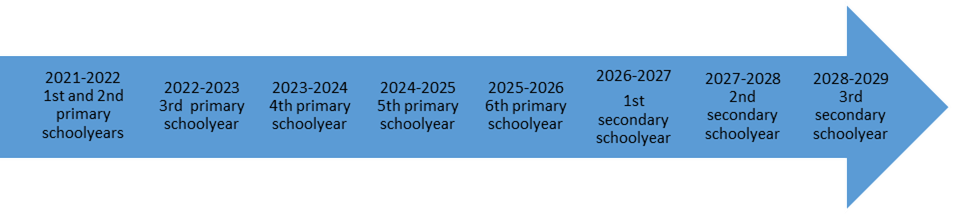
The organisation of this common core comprises three types of education : pre-primary, primary and lower secondary education, and for a duration of 12 years (from 3 years to 15 years).
The objectives of the Pact for Excellence in Teaching are as follows :
- to adapt skills and knowledge to the needs of the school of the 21st century ;
- to improve pupils' educational pathways and fight against failure and inequalities at school ;
- to support and invest in teaching teams to enable them to meet the challenges of the 21st century school ;
- adapting the governance of the school system in order to make its various stakeholders accountable ;
- improving the steering of the system and its performance and optimising its organisation and resources.
The desired aim is to strengthen basic knowledge and ensure a higher level of knowledge for all pupils.
The Pact for Excellence in Teaching in its Opinion No 3 proposes five strategic lines of action for the development of schools :
- teaching the knowledge and skills of society and promoting the pleasure of learning, through reinforced pre-primary education, a common polytechnic and multidisciplinary core curriculum and a revised and clarified learning framework ;
- mobilising those involved in education within a context of increased autonomy and responsibility by strengthening and contractualising the management of the education system and schools, increasing the leadership of the school head and enhancing the role of teachers within the collective dynamics of the school ;
- make the vocational pathway a path of excellence that is rewarding for each pupil and enables successful socio-professional integration, while strengthening its steering and simplifying its organization ;
- in order to improve the role of education as a source of social emancipation while focusing on excellence for all, promote diversity and inclusive schooling throughout the education system while developing strategies to fight against failure at school, dropping out and grade repetition ;
- ensure that every child has a place in a quality school, and develop school organisation to make schools more accessible, more open to their environment and better adapted to the child's well-being.
In this same reform, the Mission Decree of 24 July 1997 defining the priority missions of pre-primary, primary and secondary education and organising the structures to achieve them was amended by the Decree of 13 September 2018. The aim of this decree is to introduce a new steering framework, contractualising relations between the French Community and schools.
Responsible bodies
At the system level
In the French Community, several bodies structure the education system : the Support Service, the Directorate for Educational Standards and Evaluation, the General Service for Analysis and Foresight, the General Service for Inspection, the General Steering Service for Schools.
The Support Service
The Support Service is a transversal support administration at the service of the Government and of the General Administrations to enable them to fulfil their functional missions.
It is also an administration for coordinating the transversal policies of the French Community, enabling it to ensure an integrated and coherent approach to the Ministry's actions, as well as to become a dynamic player recognised for its steering.
The Directorate for Educational Standards and Evaluation
The Directorate for Educational Standards and Evaluation is responsible for coordinating the development of competency guidelines, ensuring the approval of programmes and coordinating the development and organisation of external evaluations (national examinations), including the processing of the resulting data.
The General Service for Analysis and Foresight
Within the General Directorate for the Steering of the Education System, the General Service for Analysis and Foresight is responsible for supervising, coordinating and implementing the projects of the Pact for Excellence in Teaching entrusted to it.
It is made up of three directorates :
- the Directorate of Data Exploitation ;
- the Directorate of Educational Policies ;
- the Observatory of Vocational Education, Professions and Technologies.
The General Inspection Service
Since 1 September 2020, the new organisation of the General Inspection Service as defined in the Decree of 10 January 2019 has come into force.
The structure of the service was redefined by distinguishing two new entities :
- an Inspection Service of the Teaching in the Pedagogical Continuum (from pre-primary to lower secondary education) ;
- an Inspection Service of upper secondary education (general and vocational).
The modalities concerning the various tasks to be carried out are specified by the Government.
The General Steering Service for Schools
The Steering Committee of the education system is an advisory body which aims to respond to the need to evaluate the functioning of the education system and to identify ways of improving the quality of education. The Steering Committee is based on the work of the General steering service for schools and psycho-medico-social centres (Decree of 13 September 2018).
This General Steering Service is in charge of the contractualisation with the schools.
At institutional level (School heads and educational teams)
As stipulated in the Decree of 2 February 2007 fixing the status of school heads, the School head implements within the school the pedagogical project of his organising authority within the context of the educational policy of the French Community.
In education organised by the French Community, the School head is the privileged contact and collaborator of the Government services and the General Inspection Service.
In subsidised education, the School head is the representative of the organising authority in dealings with government departments and the General Inspection Service.
Another body of pre-primary, primary and secondary education.
Participation Council
The Participation Council is the only place where the educational team, the organising authority, the parents and the representatives of the economic and social environment of the school sectors meet and express themselves. It is a central lever where each stakeholder is represented.
The legislator has entrusted the Participation Council with a number of missions. These are divided into missions common to all the councils and specific missions depending on the level, form of education and network to which the institution belongs. The Participation Council has advisory powers and obligations in the exercise of its missions.
Approaches and methods for quality assurance
Non-school childcare facilities
The Office for Birth and Childhood (ONE) issues a quality attestation to institutions and services which comply with the childcare quality code and submit to the Office’s monitoring (decree of 17 July 2002). This quality code is defined in the decree of the Government of the French Community of 17 December 2003. It sets out the goals to be achieved and stipulates that each childcare facility must draw up a plan in conjunction with the childcare workers. The plan must also be the object of a consultation exercise in which parents and guardians who use the service are invited to participate. The plan must provide at least the following information :
- the type of care provided ;
- the internal regulations ;
- the institutional context in which the facility operates ;
- the method for determining the financial contribution of parents and guardians ;
- staffing levels ;
- the qualifications of the staff ;
- a description of the methodological choices and the concrete actions performed with a view to achieving the goals of the quality code defined by the government.
The childcare facility plan is the subject of regular evaluations and is updated at least every three years. Any facility which applies for it and undergoes the monitoring of ONE receives a quality attestation following an evaluation of its childcare facility plan in the light of the quality code defined by the decree, and an evaluation of whether the facility is has genuine plans to improve the quality of care in line with one or more of the goals defined by the quality code. The appropriateness of the means employed in order to achieve this is also evaluated.
The quality attestation granted by ONE has a three-year period of validity and is renewed if the plan defined by the facility has actually been implemented.
In order to obtain a quality certificate, a childcare center must commit to improving the quality of the reception in relation to its educational project. Quality improvement projects are determined as a team and in agreement with the Office for Birth and Childhood (ONE : Office de la naissance et de l’enfance) for a period of 3 years. Resources (human and material resources) are allocated for the implementation of these projects. During the 3 years, the teams work on these projects. Periodically, the ONE agents invite the teams to take a break from these projects and at the end of the 3 years, the childcare center carries out its self-evaluation. A co-evaluation (Childcare facility / ONE) also takes place which allows for the identification of progress and problems.
From the end of 2021, the quality improvement process will take on a new form with operational assessments. This process will apply to all childcare facilities (including home childminders and non-subsidised structures).
For a new childcare facility, an initial "freeze frame" will take place one year after it has started and at 3 and 5 years of age. For all other structures, quality improvement projects will be defined for 5 years. There will be an evaluation at the mid-point and at the end of the 5-year cycle.
To support the quality improvement projects, workshops for exchange of practices and study days are organised in the different sub-regions on the initiative of educational advisers in collaboration with front-line staff.
The ONE, through agreements with training operators, supports the implementation of training modules aimed at different audiences of childcare facilities. Through a training programme decree, more than 1000 training days are carried out each year for the early childhood sector. The new 2021-2026 training programme will soon be approved by the Government of the French Community.
Moreover, ONE is required to submit an annual activity report to the government (decree of 17 July 2002). In particular, this report enables ONE to give an update on its achievements and its work, to raise their profile and to discuss them with policymakers and civil society.
Pre-primary, primary and secondary education
Three main schemes are employed at different levels of the system, from the micro-systemic (pupils) to the macro-systemic (the whole of the education system) :
- The work of the inspection services, whose evaluation function is developing while its checking function diminishes, gives rise to reports about institutions and in certain cases about teachers, as well as about the system as a whole; unless there is a specific assignment, these are primarily qualitative analyses ;
- External assessments, both certificative and non-certificative, inform teachers about individual pupils’ skills, and inform each institution about the level achieved by its pupils. Moreover, these assessments provide general input for processes of reflection at the different levels of the education system ;
- Educational indicators, published every year, relate to the system as a whole; a recent plan makes provision for certain indicators to be implemented at the level of each institution in the TABOR scheme (table with a set of administrative and statistical figures).
One of the system’s characteristics is the separation between the points observed and the assistance which is granted: thus, since the adoption of the decree of 8 March 2007, the evaluation of institutions has fallen within the competence of inspection services which are completely independent of the schools and controlling authorities, but where difficulties are encountered, it is separate services, overseen by the controlling authorities, which are called upon to intervene in the schools and classes to support and assist the people concerned to resolve the problems that have been encountered (by means of visits by educational advisers).
This evaluation system is a dynamic one: its systematic character is a relatively recent feature, and it is evolving, adapting, and gradually becoming more comprehensive as it acquires more experience, on the basis of the strengths and weaknesses that are observed.
The education system steering committee
The General Steering Service is in charge of the contractualisation with the schools and includes in particular :
- 9 Zone Directors ;
- 88 Delegates to the Contract of Objectives.
The Zone Directors are responsible for the coordination and supervision of the Delegates to the Contract of Objectives in their zone, in particular with regard to :
- the procedure for the contractualisation of the steering plans ;
- the monitoring of their degree of achievement and the evaluation of the Contracts of Objectives ;
- the contractualisation procedure for adjustment mechanisms ;
- the monitoring of their degree of achievement and the evaluation of the collaboration protocols ;
- with the Coordinating Delegate, the motivated management of an institution in the event of persistent disagreement with the Delegate to the Contracts of Objectives ;
- the analysis of the requests for audits to be carried out by the General Inspection Service ;
- inter-network coordination by zone ;
- the drawing up, every year, of the activity report for their zone ;
- the formulation of opinions and proposals, on their own initiative or at the request of the Government, on everything that falls within their competence ;
- the exercise of all other tasks entrusted to them by laws, decrees and regulations as well as all missions assigned to them in the interest of the service by the Coordinating Delegate.
The Delegates to the Contract of Objectives are responsible for :
- the contractualisation procedure for the steering plans, the monitoring of their degree of achievement and the evaluation of the Contracts of Objectives ;
- the contractualisation procedure for adjustment mechanisms, monitoring and evaluation of their degree of achievement and the evaluation of the implementation of collaboration protocols ;
- the procedure for contractualisation of steering plans, monitoring of their degree of achievement and evaluation of the Contracts of Objectives concluded between a psycho-medico-social centre and the Government ;
- the organisation of the awarding, marking and external jury of the common external test (national test) leading to the awarding of the Certificate of Primary Education, as well as the organisation of the awarding, marking or jury of all external certification tests (national tests) ;
- the formulation of opinions and proposals, on their own initiative or at the request of the Government, on all matters within their competence ;
- participation in working groups, commissions and councils, in accordance with laws, decrees and regulations ;
- the exercise of all other tasks entrusted to them by laws, decrees and regulations as well as all other missions assigned to them in the interest of the service by the Coordinating Delegate or the Zone Director to whom they report.
The inspection services
The various inspection services are staffed with experienced former teachers who only inspect the subjects that they have taught, and at the educational level at which they used to work as teachers.
The inspectors are responsible, each in their own right or in collaboration with each other, for auditing missions, specific investigation and control missions, evaluation missions following a presumed substantial breach, missions relating to the assessment of the pedagogical aptitude of a member of the education team's staff.
School heads
School heads must in particular :
- ensure the management and coordination of the teaching staff, of relations with pupils, parents and third parties, and of external relations, and ensure the running of the participation council ;
- manage the institution’s material and financial resources, organise timetables, manage pupil records, etc ;
- ensure the educational and pedagogical management of the institution (implementing the school plan, ensuring that what is learnt corresponds to the guidelines stipulated by legislation) ;
- ensure that certificative assessments and external assessments within the school are organised properly ;
- coordinate and circulate information (results of external assessments, inspection reports, opinions given by Centres for Psychological, Medical and Social Services, etc.) and ensure that the data gathered at the school is collated and passed on to the authorities (annual report, notification of specific problems, etc.).
At institutional level (School heads and educational teams)
The School head and the team draw up a collective diagnosis of the school, listing its strengths and weaknesses in relation to the objectives for improvement, as well as their causes.
This diagnosis is based on a list of indicators specific to the institution, compared with those of comparable institutions. These figures are transmitted to the school head and the organising authority by the Administration.
The indicators and diagnoses are confidential and exclusively reserved for the school, except for the elements necessary for the presentation of the steering plan to the Participation Council. The school may use additional elements to establish its diagnosis.
On the basis of this analysis, the teaching team chooses the specific objectives (it is recommended that three to five be defined) which it intends to pursue in order to contribute to the objectives of improving the education system as a whole. In relation to its objectives, it defines annual and multiannual numerical reference values, which are also confidential.
The team then draws up strategies/action plans to be implemented in order to achieve its objectives : new initiatives or actions to be pursued in fifteen areas such as school retention, guidance, reasonable accommodation, etc. The team then draws up a plan of action to be implemented in order to achieve its objectives. The school also presents its collaborative working methods, its training plan and the methods for implementing the core curriculum.
The decree of 13 September 2018 specifies that the entire plan is drawn up by the school head, in collaboration with the pedagogical and educational team and, where appropriate, in consultation with the CPMS and parents' representatives. It is obviously based on the realities and resources of the school. As this is a major overall effort, the schools rely on the help of an intermediate group set up within the school (a team responsible for the steering mechanism).
Before becoming a "Contract of Objectives", the steering plan must receive the agreement of the organising authority and the opinions of the social consultation bodies and the participation council. It must then go through the Delegates to the Contract of Objectives and the Zone Directors.
The Delegates to the Contract of Objectives (under the supervision of the Zone Directors) analyse the appropriateness of the steering plan in relation to the school's situation and improvement objectives, and its compliance with the decree. If the steering plan complies with the objectives and the decree, it is signed by the Zone Director and the organising authority representative, countersigned by the Delegate to the Contract of Objectives and the school head, and becomes a Contract of Objectives.
The Delegate to the Contract of Objectives’ analysis of a steering plan is carried out within a context of constructive dialogue and negotiation.
Each year, the institution evaluates internally, collectively, the achievement of its Contract of Objectives in order to introduce possible corrective actions. This self-assessment does not have to be communicated to the Delegate to the Contract of Objectives, but this does not prevent regular dialogue between the school head and the Delegate to the Contract of Objectives. The Delegate to the Contract of Objectives carries out an intermediate evaluation after three years, and a final evaluation at the end of the six-year contract, always in dialogue with the school.
In response to the intermediate evaluation and the review of the results, a modification of the objectives may be envisaged. The contract of objectives does not impose an obligation of result on schools, but rather an obligation of means.
At pupil level
The quality of education is analysed on the basis of the pupils’ results in various external tests : the certificate of primary education (CEB), various external certificative examinations, which are common to all schools, with respect to the certificates and diplomas associated with secondary education, and external non-certificative assessments.
External non-certificative assessments measure the pupils’ skills in the light of the expected attainment at the end of the cycle, to enable teachers to identify the level that their pupils have reached, estimate how much ground remains to be covered during the current year and adapt their teaching in the light of this information. A formative diagnostic test is used, based on the core skills and final attainment targets. These tests are devised by working groups consisting of people with complementary areas of expertise and from the different networks: inspectors, educational advisers, school heads, coordinators of continuing training, the coordinators of the General Steering Service and researchers.
Participation in various international assessments provides yet another perspective on what pupils learn in the French Community: for example, PISA (the Programme for International Student Assessment – 15-year-olds), PIRLS (the Progress in International Reading Literacy Study – pupils from the fifth primary year) and ESLC (the European Survey on Language Competences – pupils from the fourth secondary year).
In addition to these external assessments, internal appraisals take place within classes. At this level, the assessment of pupils falls within the competence of various bodies: some such assessments are specific to the school itself or to the controlling authority (which, subject to compliance with the laws and decrees, may define the methods and frequency of these assessments, the grading system, etc.); other pupil assessments are arranged by individual teachers; others again are the responsibility of the Centres for Psychological, Medical and Social Services (CPMS).
The participation council
The legislator has entrusted the Participation Council with a number of missions. These are divided into missions common to all the councils and specific missions depending on the level, form of education and network to which the institution belongs. The Participation Council has advisory powers and obligations in the exercise of its missions.
Concerning the project of the institution, the Participation Council must :
- discuss on the basis of proposals brought by the delegates of the organising authority ;
- amend or add to it according to the consensus procedure or, failing that, by vote as defined in the decision-making procedures ;
- put it forward for the approval of the organising authority ; propose, if necessary, adaptations in line with the steering plan ;
- check the consistency between the project of the institution and the steering plan.
Concerning the Steering Plan, the Participation Council must :
- submit an opinion on the steering plan before it is sent to the Delegate to the Contract of Objectives for analysis ;
- submit an opinion on any proposed modifications to the contract of objectives made by the institution following the intermediate evaluation of its implementation.